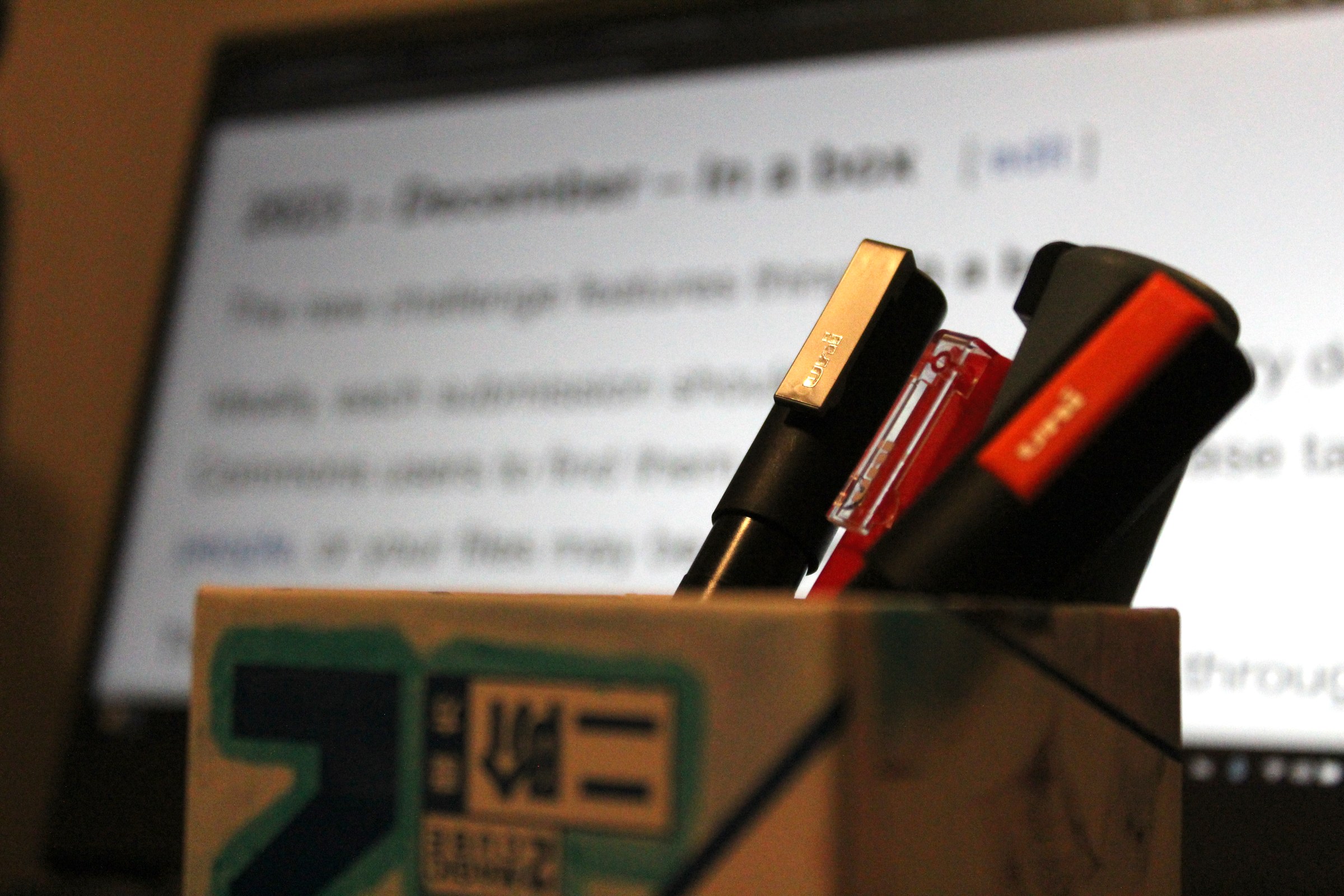

Photo: A box of POSCA paint markers. Reunion / Wikimedia Commons, CC BY 4.0.
Which paint pen works on glass, wood, fabric or a rock is mostly a question of what the surface does to the paint, and sealing follows from the same logic. POSCA markers are water-based paint pens with stable pigments, and the brand describes them as applicable to all materials. What changes from one material to the next is whether the mark stays put on its own, wipes off with a damp cloth, or needs varnish or heat to fix it.
The practical version: porous surfaces drink the paint and hold it. Smooth surfaces let it sit on top, where a wet rag can lift it. Everything below follows from that split, and all of it comes from POSCA’s own FAQ and support pages.
Porous or smooth: the one rule that decides everything else
POSCA states it plainly: “POSCA paint is permanent on porous surfaces and erasable on smooth surfaces.”
On the porous side, the FAQ says: “It is permanent with no need for fixatives on porous materials such as wood, cardboard, textiles, pebbles, certain plastics and metals.”
Where fixing is needed, POSCA lists three methods depending on the material: applying a water-based spray varnish for most materials, passing it via the kiln for porcelain, or heating it with the iron for fabric.
Two points are easy to miss. First, “no need for fixatives” is not the same as “never varnish it”. POSCA still recommends a water-based aerosol varnish on wood and on anything going outdoors, and says you can varnish stones. Second, drying is quick either way. The FAQ says the paint dries extremely fast, faster on porous surfaces than on smooth ones, and in any case takes no more than a few minutes.
Use that as your sorting rule before you pick up a pen:
- Porous: wood, cardboard, textiles, pebbles, and certain plastics and metals. The paint sinks in and stays.
- Smooth: glass, window panes and display cases, porcelain. The paint sits on top and can be wiped away unless it is fixed.
Glass wipes clean; wood and rocks hold on
Glass is the surface most often misunderstood. A POSCA mark on a window or a display case is erasable, which is exactly why those surfaces suit seasonal lettering so well. For lettering on cards and December spreads, there is a separate guide to festive hand-lettering ideas for Christmas cards. The FAQ is blunt about aftercare: “All you need is a damp rag to clean your creations.”
There is one caveat worth knowing before you letter a vintage window. If there is a scratch on a very old pane that has become porous on its surface, POSCA says the pigments can become encrusted and will no longer be erasable. Check an old pane before committing to it.
Before you draw on glass, the glass support page asks for a clean surface that is neither damp nor greasy. Lines work well straight off. Filled areas may need several coats, with a few minutes’ drying between each. Mistakes come off with a damp cloth while you work.
To make glass work last, POSCA says: “You can make your creation permanent, though not for food use, by applying two coats of water-based spray varnish.” Hold the can about 30 cm from the surface and spray in slow circular movements. Decorated items can no longer be used in contact with food, which rules out the inside of tumblers, plates and anything a drink touches.
Wood behaves the opposite way. It is porous, so it holds the paint, and the wood support page warns it “will absorb a lot of paint”. Several coats may be needed for solid color. Prep depends on what you have:
- Treated or varnished wood: roughen the surface with sandpaper first.
- Recovered wood: clean with water and a soft sponge, then leave to dry.
Once the piece is finished and dry, POSCA’s instruction is to “apply two coats of water-based spray varnish”, again at about 30 cm in slow circular movements, in matte or gloss. For anything living outdoors, the FAQ gives the same answer: a water-based aerosol varnish.
Rocks and pebbles follow the wood logic. The minerals support page asks you to respect the environment and public property, then to clean the stone and make sure the surface is not damp. Mineral materials are naturally porous and absorb paint, so several coats may be needed. Once the work is finished and dry, POSCA says, “you can apply two coats of water-based spray varnish to fix the results”, held 30 cm away in slow circular movements.
Fabric: wash, iron from the reverse, then launder gently
Textiles are porous, so the paint holds, but heat is what locks it in. Work through the fabric support page in order:
- Wash first. Machine-wash new fabric to remove industrial coatings, or used fabric to remove dirt.
- Pad the back. Natural materials absorb the paint more heavily, so put absorbent material underneath.
- Let it dry, then iron. The FAQ says: “To fix, iron inside out with no steam to prevent the paint from flaking.” Mind the temperature, and lay greaseproof paper between the iron and the fabric if you prefer.
- No iron? Use a hair dryer. If the fabric cannot be ironed, hold the dryer 30 cm away and move in small circular movements.
- Wash it kindly. POSCA also recommends washing the fabric inside out at low temperature to conserve the creation over time.
Whatever the surface, the pen has to be primed before any of this works. Shake the marker firmly with the cap closed so the ball mixes the paint. Press the tip down on paper several times to saturate it. Then test the flow on scrap paper until the line runs evenly. If the nib floods, dries out or skips mid-stroke, the fixes live in this guide to troubleshooting an acrylic paint pen.
Dry times stay short across the board: a few minutes at most, quicker on porous surfaces than smooth ones. Varnish only after the paint is fully dry, and give glass work its two coats if you want it to survive more than a damp rag.
Pinterest pin: typography added to a crop of the same photograph for this article. Adapted from Reunion, CC BY 4.0, via Wikimedia Commons.