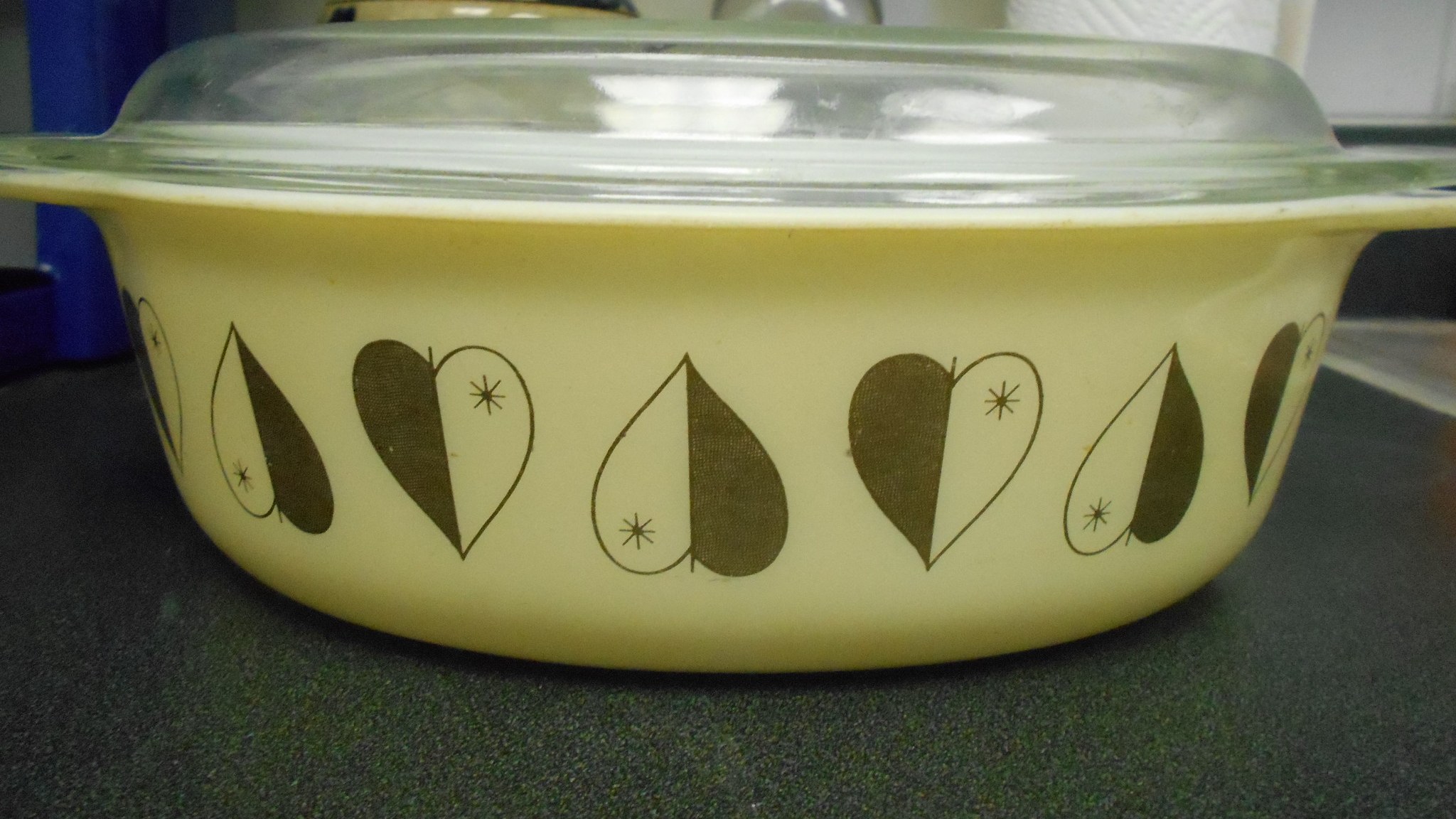
Photo: A vintage Pyrex casserole with a gold print (not the Turquoise Golden Birds pattern). Joelk75 / Flickr, CC BY 2.0.
A 1960s Pyrex casserole in the Turquoise Golden Birds pattern sold for $7,550 on eBay on February 18, 2024, after five bids.
The sale sits in the completed-listing archive at Collection Hero, which holds the record of that sale under the listing title “VERY RARE 1960s Turquoise Gold Birds Vintage Pyrex, 2-qt, 575-B with Lid” (eBay item 335235175271).
One opened record is one dish on one day, not a price guide. What it gives you is a figure with a date attached, a bid count, and a specific mold number to check against anything you find on a thrift store shelf.
The $7,550 eBay sale, and what Turquoise Golden Birds is
Writing for House Digest on August 30, 2026, Kimberley Spinney said the pattern “was never actually released, beyond as a potential promotional item gifted to Corning Glass Works employees in the ’60s.” It also “was only produced on the rectangular 2-quart casserole dish with a clear glass lid” — the 575-B space saver.
So there is no matching set to chase. One shape, one size, one lid.
What to look for:
- Shape and code: a rectangular 2-quart casserole marked 575-B, with its clear glass lid.
- The print: a turquoise exterior with gold birds on a branch, an abstract print with scroll work and a stripe with diamonds.
- The lid: it carries a design too. The gold paint on the lid, Spinney wrote, “has been shown to wear away easily,” so wear there is in character for the pattern.
- The backstamp: the Pyrex trademark in all capital letters, with the 575-B code and the “Made in USA” backstamp.
The February 2024 listing described excellent condition with the matching original lid and “one slight surface scuff on lid, roughly 1-inch.” That same listing described the dish as “only 10 known in existence,” which is seller copy rather than a census. Separately, House Digest cited WorthPoint for a figure of about 10 confirmed examples.
Treat both numbers as estimates rather than a tally anyone has verified. The practical point is narrower: this is a pattern you identify by a single shape and a single code, so you can rule it in or out quickly.
Other patterns with opened sale records, like Gooseberry at $4,280
Patterns that actually reached kitchens are the ones you have a realistic chance of finding, and some of those carry serious numbers too.
Collection Hero also holds a record for a Vintage Pyrex Gooseberry 443 Cinderella Mixing Bowl 2-1/2 Qt Pink on White, which sold for $4,280.00 on eBay on September 17, 2023.
That is a piece plenty of collectors can picture by name: Gooseberry, pink on white, in the Cinderella form, carrying the 443 mold number and a 2-1/2 quart capacity. Those four details are exactly what you check on a shelf, in that order.
A few things worth keeping straight when you read figures like these:
- Each one is a single completed sale, not an average and not an appraisal.
- Condition drives the result. Dulled color, scratches through the print, and a missing lid all pull a price down.
- Printed and gold-decorated surfaces are the vulnerable part of vintage Pyrex, which is why hand washing is the safer habit for decorated pieces.
- A seller’s claim about scarcity sits in the listing, not in a reference. Check it against the backstamp and the mold number instead.
If you are building a hunting list before the next thrift store run, it helps to learn two or three pattern names properly rather than memorizing a long roster. The thrift finds archive is a good place to start that habit.
How to date the piece on your shelf from the backstamp
You do not need a sale record to work out roughly when a piece was made. The Pyrex Collector blog’s guide to dating Pyrex kitchenware says age is most often estimated from the backstamp, and lays out the markers in order.
- Around 1950 or shortly after: the ® was added. The wording became TRADE MARK above the name and MADE IN U.S.A. below, with a model number and, later, a capacity. OVEN WARE appears below.
- Late 1960s: some pieces moved from the circular backstamp to a straighter text format, with PYREX ® plus the model and capacity above and MADE IN U.S.A. below.
- Mid-1970s onward: equivalent metric capacities were embossed, so a metric-marked piece dates later than that.
- Later still: marks may read “by CORNING, Corning, NY, USA” with “NO BROILER OR STOVETOP,” or later “BAKING AND MICROWAVE.”
Two more checks are useful. Cinderella shapes, including that Gooseberry 443 bowl, date from 1958 or after, so the form itself sets a floor. And a pattern’s introduction year narrows things further once you have identified the print.
One common mistake to avoid: the mold numbers around the stamp are not dating clues.
Run those checks on whatever is already in your cupboard before you go shopping. A dish with a circular OVEN WARE stamp, a model number, and no metric capacity sits in a different era from the one beside it with microwave wording — and reading that difference confidently is most of the skill. Carry the same three questions into the store: what is the shape, what is the mold number, and what does the backstamp say. Price guides change. Those three answers do not.
Pinterest pin: typography added to a crop of the same vintage Pyrex casserole photograph (not the Turquoise Golden Birds pattern). Adapted from Joelk75, CC BY 2.0, via Flickr.