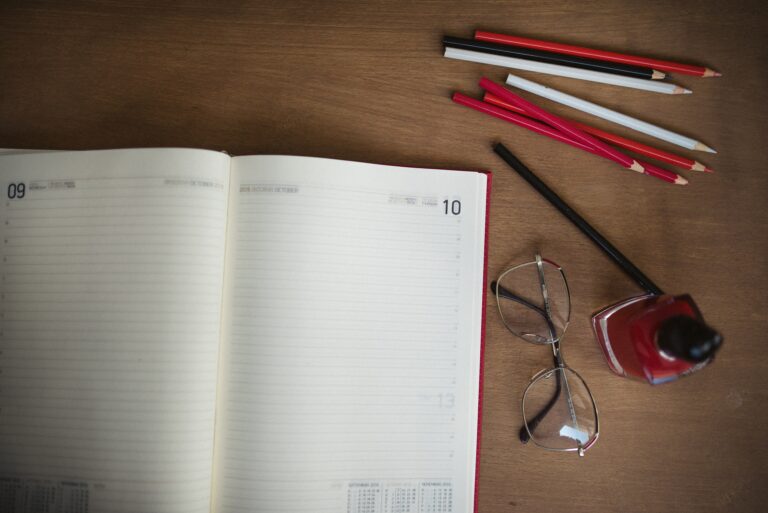
Photo: A notebook, pens and glasses on a desk (a stand-in photograph, not a Stalogy product). Shixart1985 / Wikimedia Commons, CC BY 2.0.
The STALOGY Editor’s Series 365 Days Notebook Grid is an undated grid notebook with a timeline printed down every page, so one book can run as a journal, a day planner or a sketchbook once you add the dating yourself. STALOGY’s description on the 018 product page puts it this way: “The minimal details (dates, days of the week, grids and numbers indicating times) of this simple-styled notebook make it possible to use as a journal, day planner or sketchbook.”
That is the whole idea. There is no printed calendar to work around, no pre-set weekly spread, and nothing wasted if you start in February or abandon a layout in March.
Pinterest pin: typography added to a crop of the same desk photograph for this article. Adapted from Shixart1985, CC BY 2.0, via Wikimedia Commons.
What is printed on the page (and what is not)
Every page carries the same light printing:
- Hour numbers running down the edge of the page, described by STALOGY as a timeline grid.
- Marks for the date, the day of the week and the month. The Japanese page sums this up as “Can show date, day of the week & month”. You fill them in or circle them.
- A thin gray grid behind everything, so the ruling stays quiet under handwriting, lists or drawings.
What is missing is the year and the calendar. Nothing commits the book to 2027, or to any other year, which is exactly why a 2027 setup is possible: you supply the dating.
Page counts are fixed. The 365 Days Notebook has 368 pages (184 sheets). The 1/2 Year Notebook is the shorter version at 192 pages (96 sheets). STALOGY describes the paper as thin, and writes on the product page: “For a notebook with a total of 368 pages, it looks sleek and is easy to carry because of the thin paper that is used.” As with any thin paper, try your wettest pen on a back page before you commit a whole year to it.
If you are also weighing a book that arrives already dated, line this one up against a dated Japanese planner before you buy; this comparison of the Hobonichi Techo and the Weeks for 2027 covers the trade-off between printed dates and a blank slate.
Pick the size by the timeline hours, not just the page size
The four sizes do not all print the same hours, and that decides whether the timeline works for early starts and late evenings.
- A6 (105 × 148 mm) — timeline 8:00–21:00. Pocketable, with a working day already bounded for you.
- B6 (128 × 182 mm) — timeline 7:00–23:00. A middle option with room for an early start and a late finish.
- A5 (210 × 148 mm) — timeline 0:00–24:00. A full 24-hour day, useful for shift work, feeds, sleep logs or travel.
- B5 (257 × 182 mm) — timeline 0:00–24:00. The desk-sized version of the same full-day timeline.
Two questions settle it. Do you need hours before 7:00 or after 21:00 on the page? And will the book live in a bag all year, or on a desk? Choose the hours first, then the format.
Set it up as a 2027 one-page-a-day planner
2027 is not a leap year, so you are dating 365 days, and 1 January 2027 falls on a Friday. Work through the setup in one sitting:
- Decide the format before you write anything. The How to use 365 Days Notebook page sets out several approaches, including monthly, weekly and one page a day, plus printable format overlays you can lay over the grid.
- Work out where the spare pages go. A 368-page book minus 365 dated days leaves three. Give them to a front index and a year overview, or keep them at the back for a reading list or a running log.
- Date the first page. Mark the month as January, the date as 1 and the weekday as Friday, then carry on page by page through the year.
- Batch the dating by month. Filling in a month ahead at a time is faster than doing it daily, and it leaves you free to skip forward to a page in April when something lands early.
- Mark your month breaks. A tab, a corner triangle or a bold line on the first page of each month gives you something to thumb to, since nothing is pre-printed.
- Keep trackers on the daily page. One page a day plus a dedicated page at the start of each month comes to 377 pages, which does not fit. Shrink the tracker into a corner of the daily page, or move to a weekly format and give the freed-up pages to collections. These habit tracker layouts for 2027 scale either way on a grid.
The 1/2 Year Notebook works the same way on a shorter run: 192 pages gives roughly six months at one page a day, which suits a January start with a July restart, or a book that follows a term or a single project.
If one page a day feels like too much white space, use the hours on weekdays for appointments and switch to a weekly spread across two pages for quieter stretches. Because nothing is pre-printed, you can change format mid-book and simply date the next page as the new layout begins. That flexibility is the trade: a dated planner does the admin for you, while this one asks for twenty minutes of setup and then bends to whatever the year turns out to need.