Photo: A notebook and coloured pencils on a wooden desk (a stand-in photograph). Shixart1985 / Wikimedia Commons, CC BY 2.0.
A year in pixels gives each of the 365 days in 2027 its own small square, colored from a short key you choose. One page holds the whole year, so a single glance shows every day you logged.
The usual build is a grid: twelve columns across for the months, up to 31 rows down for the dates. Fill one square a day, and by 31 December the page is a block of color you can read like a chart.
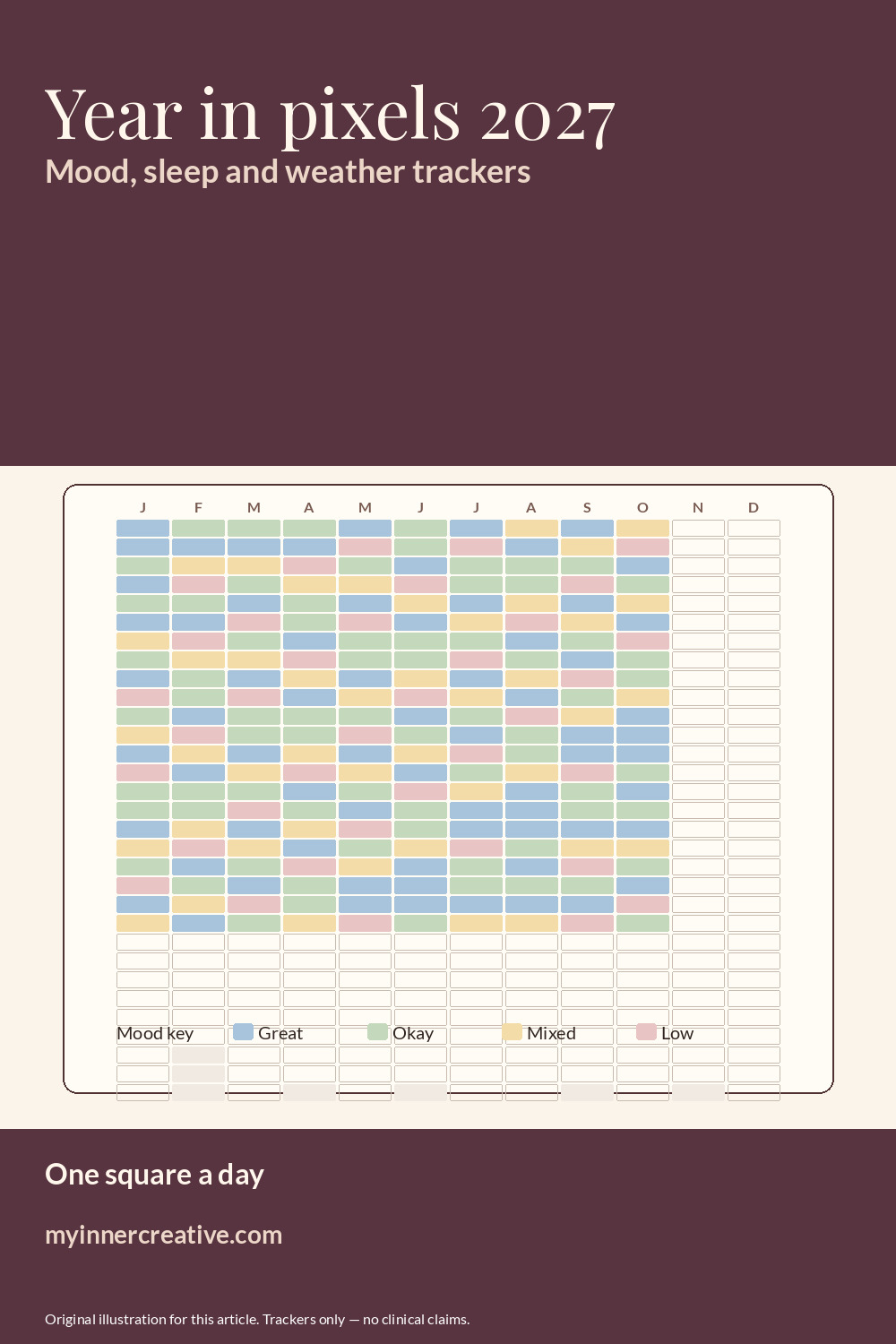
Illustration: an original pin for this article, showing a 2027 year-in-pixels grid, partly coloured, with a small mood key and typography added. Trackers only; no clinical claims.
2027 is straightforward to set up. The year has 365 days and opens on Friday 1 January, so the first weekend squares are 2 and 3 January in the first column.
Rule the grid: 12 columns, 31 rows, 365 squares
Work on one page if you want the year on a single side, or across a double spread if you want bigger squares. Count your dots or lines before ruling so 31 rows fit the page height.
- Draw twelve columns across the page and label them Jan to Dec.
- Draw up to 31 rows down the page and number them 1 to 31 along the outside edge.
- Block off a corner, or the facing page, for the key.
- Cross out rows 29, 30 and 31 in the February column: February has 28 days in 2027.
- Cross out row 31 in April, June, September and November, the four 30-day months.
That leaves seven blank squares in a 372-cell grid, and 365 to color. Shade the crossed cells gray, or hatch them lightly, so there is never any doubt about whether a day was missed.
Two optional extras are worth ruling in while the pencil is out. Shade weekend squares a little lighter than the rest, counting from Friday 1 January. Add a thin line under every fifth row so your eye can find the 15th or the 25th without counting.
Keep the pencil lines faint and go over the outer frame in pen. A grid that is quick to read is a grid that is easy to keep filling.
Build a key: mood, sleep or weather versions
The key does most of the work. Four colors is plenty, and a short key keeps the daily decision quick, which matters when the whole habit is one square a night.
Here are three illustrative keys to adapt. None of them is an official system, so change the wording to match how you actually describe your days.
Mood version
- Great: yellow
- Okay: green
- Low: blue
- Mixed: purple
A pixel grid like this is simply a record of what you noticed at the end of the day. If you want more room to write alongside the colors, a full mood tracker spread in a bullet journal gives each month its own page.
Sleep version
- Long: dark blue
- Average: mid blue
- Short: pale blue
- Broken: orange
One color family works well for sleep because the shades line up with the thing you are logging. Keep the odd-one-out color for broken nights so they stand out down the column.
Weather version
- Sun: yellow
- Cloud: gray
- Rain: blue
- Snow: pale lilac, or left white with a dot
Weather is an easy version to start with, because the answer is rarely in doubt and a missed week can be filled in from memory or a forecast app.
Whichever key you pick, draw the swatches before January and write the label next to each one. Colored pencils are forgiving on thin paper; fineliners and brush pens can show through, so test them on a back page first.
Fill it in daily, and plan for the days you miss
Decide when the square gets colored and tie it to something you already do. A common setup is the notebook on the bedside table with four pencils clipped to the cover or dropped in a small pouch.
Gaps happen. Three ways to handle them:
- Catch up weekly. Sit down on Sunday and fill the last seven squares at once.
- Leave blanks. An empty square still tells you something, and it keeps the grid honest.
- Carry a pocket note. Jot a letter a day on a card while traveling, then transfer the colors when you get home.
The grid also pairs well with the rest of a yearly setup. Put it opposite your habit tracker layouts for 2027 so the daily marking happens in one sitting, and keep logs with a different rhythm, such as film and series watch trackers, on their own spread.
Reading the finished page is simple. Read down a column to see one month. Read across a row to compare the same date in all twelve months. Step back and the long runs of one color are visible from across the room.
If the whole year feels like a lot to commit to in January, rule only the first three columns and add each new month on the first of the month. The grid still ends up complete, and the page stays tidy until you get there.