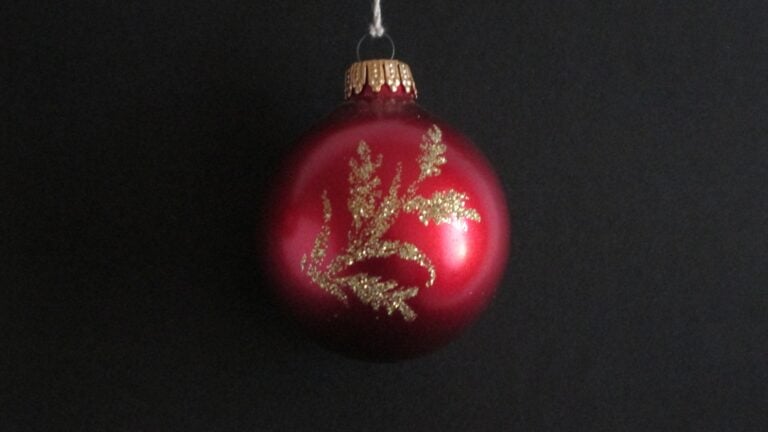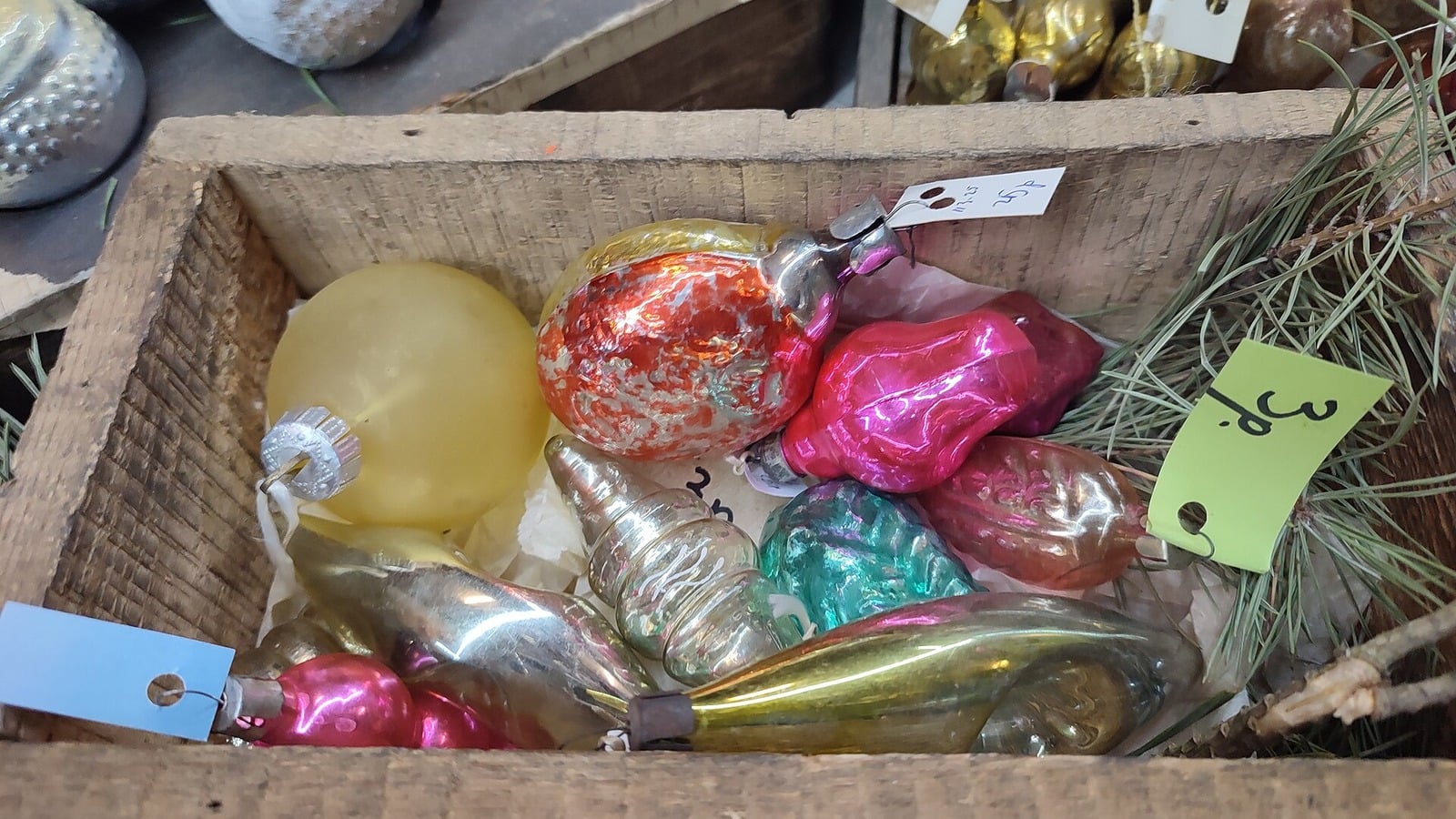
Three kinds of old Christmas ornament are worth digging for in a jumbled box at a car boot sale: mid-century Shiny Brite baubles made in the United States, silvered blown glass of the same era, and the thick German kugels blown between roughly 1840 and 1914. What separates them from modern plastic and mass-market reproductions is glass that stays cold in the hand, a rough glass stub hidden under the cap, and interior silvering that has aged unevenly over decades.
The trade name mercury glass is a misnomer. The Just Vintage Christmas FAQ states that collectible glass ornaments contain no mercury. They are single-walled blown glass silvered on the inside, unlike the 1840s double-walled household mercury glass that lent the term.
Collectors generally treat ornaments from the 1930s to 1960s as the core vintage field, with 100 years or more counting as antique. Most early blown glass came from Germany, especially the Lauscha region from the mid-1800s. Japan, Czechoslovakia and Poland followed in the mid-1920s to 1930s, ahead of American mass production.
Hand checks that rule out plastic in seconds
Pick the ornament up before looking at anything else. Antique Identifier sets out a short sequence of physical tests that work in a crowded aisle.
- Temperature. Blown glass feels consistently cold held against a cheek. Plastic warms up fast.
- Mold seam. Plastic baubles typically show a visible vertical mold seam running around the circumference. Hand-blown glass does not.
- The pike. Slide the metal cap off. Hand-blown ornaments show a jagged, unpolished glass neck left when the piece was removed from the blowpipe. Modern machine-made necks look smooth, thick or threaded.
- Foxing. Spotted or flaking interior silvering, left by silver nitrate, plus tarnished caps, are normal signs of age. Blindingly bright mirror silvering, or uniform painted “dirt” sitting evenly in the crevices, points to a modern fantasy fake.
Cracked pikes and heavy exterior paint loss cut value sharply, so check the neck and the painted bands in daylight. Damaged modern glass is still useful for craft work, and a plain bauble takes decoration well if you follow a paint pen and sealing method made for the surface. Other homemade decorations in the same vein include salt dough ornaments and dried orange slice garlands.
Caps, country stamps and wartime pastels
The cap carries most of the dating information. Shiny Brite was founded by Max Eckardt in the late 1930s, working with Corning Glass Works on adapted lightbulb machines. Its crimped metal caps are marked “Shiny Brite Made in U.S.A.”, while the earliest American caps of the 1930s and 1940s read “Made in US of A”.
Wartime production looks completely different. Antique Stores Nearby records that between 1942 and 1945, with silver nitrate and metal diverted to the war effort, American ornaments were left unsilvered and finished in thin translucent pastel lacquers in pink, pale blue, mint and lavender. Caps were pressed paper or cardboard, with yarn or cotton string hangers. Hold one up to a lamp and the light passes straight through the glass instead of bouncing off an interior mirror.
German caps split by period. Pre-1900 examples are conical dome or ring caps glued on with plaster or sealing wax. From the early 1900s, spring caps hold with a two-legged wire loop, and German versions often have a thicker round loop. Look for stamped country names: “Germany”, “West Germany”, “Czechoslovakia”, a distinctive split-panel “Poland” cap, thin stamped “Japan” caps and rounded-edge “Italy” caps.
Kugels announce themselves by weight. These thick German glass balls, made from about 1840 to 1914, were lined internally with zinc or lead and fitted with a flush, tightly mounted ornate brass cap. Silver, gold and green are the most common colors. Red and burgundy are scarcer, and amethyst and dark black amethyst are the rarest.
What they sell for, and how to store them
Boxed and multi-piece mid-century lots have a wide range at auction. At Atlee Raber Auctions, a 35-piece mid-century lot with an antique glass garland sold for $200 on 12 January 2026, and Lot 173 reached $175 on 1 June 2026 for mercury glass ornaments attributed to Shiny Brite with a 12-compartment box and a 5-compartment sleeve.
- 45 assorted Shiny Brite, West Germany and Japan ornaments: $275 on 10 August 2026.
- 12 West Germany and USA Shiny Brite ornaments with box: $125 on 17 November 2025.
- 88 petite mercury glass ornaments in Shiny Brite and West Germany boxes: $30 on 9 October 2025.
Kugels trade on size and color. One Source Auctions sold a c. 1890 green kugel of 3.25 inches for $45 and a ribbed green example of the same size for $60 on 3 January 2022. A large 9-inch etched kugel made $91.50 at Nadeau’s Auction Gallery on 19 July 2025. Four kugels including blue and silver grapes took $147 at Skinner on 14 August 2007, and a pair of large late-19th-century kugels in silver and cobalt blue, with brass mountings, reached $540 at Skinner on 28 October 2012.
Those figures attach to specific lots on specific days, and the boxes do real work. Original packaging, intact tags and labels, undamaged paint and rare figural shapes all push value up, while a cracked pike drags it down whatever the maker.
Store anything you buy in a cool, dry place and wrap each piece individually in tissue. Bubble wrap can stick to old glass, and sealed plastic bags trap moisture against the silvering you were trying to protect.
Pinterest pin: typography added to a crop of the same market-crate photograph of vintage glass ornaments (not the specific lots cited). Adapted from Tess Mattew, CC BY-SA 4.0, via Wikimedia Commons. Share-alike: derivatives must use the same licence.