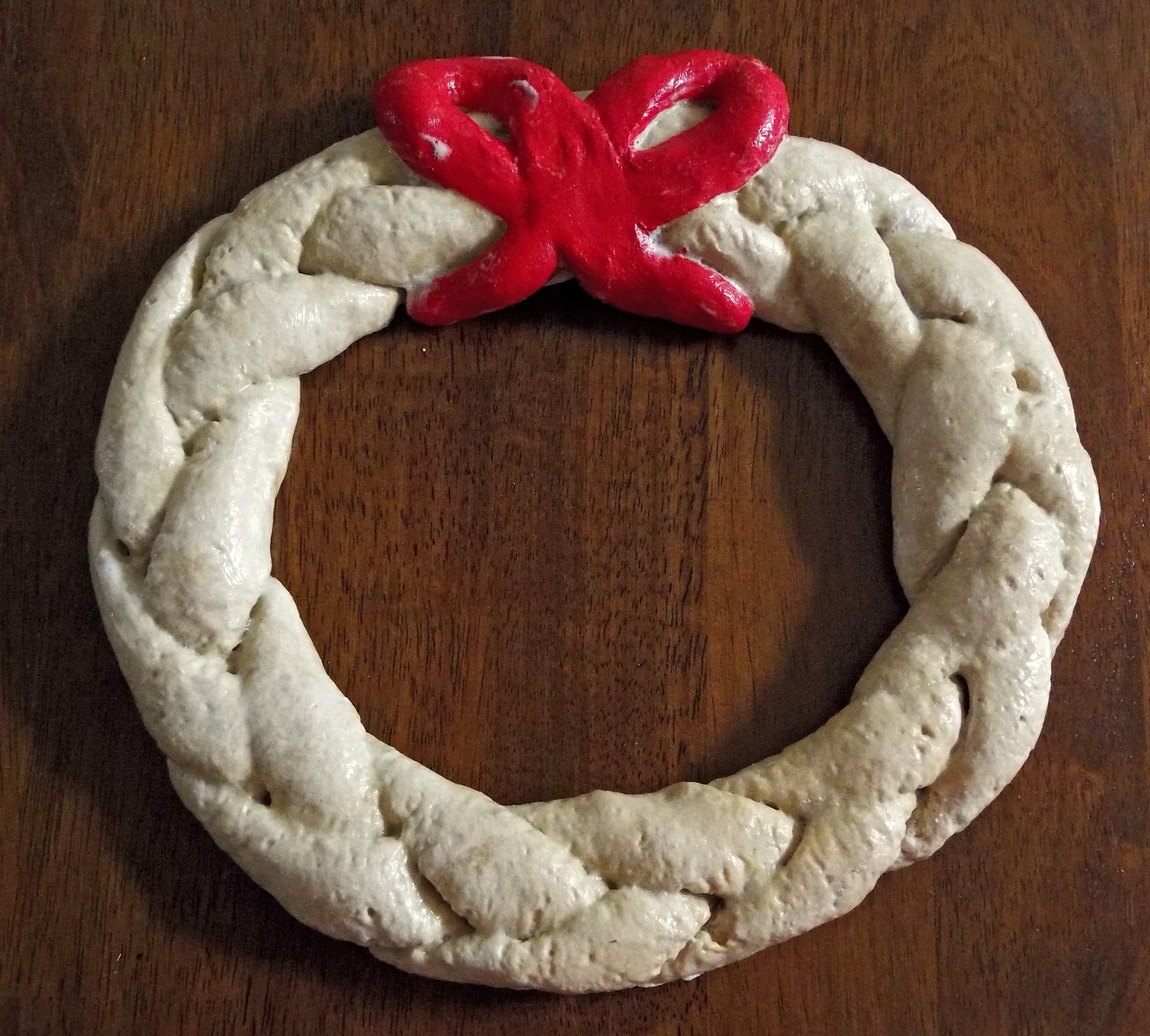
Photo: A braided salt dough wreath. Skrydstrup / Wikimedia Commons, CC BY-SA 4.0. Share-alike licence.
A salt dough keepsake is three pantry ingredients and a long wait. What separates a piece that stays hard from one that domes, splits or slumps is the drying temperature, the evenness of the roll, whether every face was sealed, and where it spends the rest of the year. The dough itself takes one line: plain flour, fine table salt and water, in roughly two parts flour to one part salt to one part water, as The Clay Desk sets it out, with a full method at The Artful Parent.
Puffing is trapped steam from an oven that is too hot
A domed, bubbled surface means the water inside turned to steam faster than it could escape, setting and browning the outside before the middle had dried. Salt dough is being dried rather than baked, which is why the recommended settings are so low. Homebody Artisan bakes at 200°F for two to three hours, turning the pieces over halfway. The Clay Desk gives around 100°C (210°F) for the same two to three hours, and calls raising the temperature to speed things up the single most common way a batch is ruined. Puddles & Play allows a wider band of 200 to 250°F (95 to 120°C), with the hotter end taking about one to two hours and more likely to brown, while Ochre Dough sets the oven to its lowest temperature for around three to five hours. The sources differ, so judge the piece rather than the dial: it is done when it is hard, sounds hollow when tapped and has no cool or damp spots.
Two other causes are avoidable before the tray goes in. Self-raising flour contains a raising agent and lifts the dough like a cookie, so check the bag and use plain flour. Dough rolled thicker than a quarter inch dries from the outside in, then either swells or stays soft in the center. Puffing also has no repair: The Clay Desk says a puffed ornament cannot be flattened afterwards, so the batch has to be remade. Air drying avoids the risk at the cost of time, two to three days on a wire rack by The Clay Desk’s count and two to five by Homebody Artisan’s, with warping more likely unless pieces are turned daily.
Cracks come from uneven drying, and hairline ones can be filled
Dough shrinks as water leaves it, so anything that dries one part faster than another splits the piece. Crumbly dough has no stretch and tears at the edges; Puddles & Play adds water a teaspoon at a time until it feels like soft clay. Under-kneaded dough carries lumps and air pockets that become weak points. Homebody Artisan kneads for five to ten minutes until the dough is smooth and firm, The Clay Desk for four or five, and both treat that as the step that gives a smooth surface without cracks.
Thickness matters more than the exact number. Homebody Artisan and Puddles & Play roll an even quarter inch, The Clay Desk about 5mm and Ochre Dough 0.5 to 1cm. A sheet that runs 3mm at one end and 8mm at the other dries at two speeds and cracks along the join, so two wooden spoons or paint stirrers laid either side of the dough help keep the depth consistent. Keep pieces away from a radiator or a sunny window while they dry, and turn them so both faces lose moisture. If a hairline crack appears anyway, The Clay Desk fills it with PVA, which disappears under paint; Puddles & Play presses in craft glue, or fresh dough mixed with glue, scrapes off the excess and paints over the patch. Puddles & Play also makes the hanging hole before drying, about half an inch in from the edge so a ribbon cannot snap the piece, and slightly wider than it needs to be, because the dough shrinks.
Sealing every face is what stops a hard piece going soft
Salt dough is hygroscopic: it pulls moisture out of the air, and an unsealed piece softens, spots with mold or crumbles over a damp winter. Paint alone does not protect it. Let pieces cool and dry completely, sand any rough edges with fine sandpaper, then brush two thin coats of clear acrylic varnish on the front, the back and the edges, with drying time between, as Homebody Artisan and The Clay Desk both advise. Ochre Dough seals with Mod Podge or watered-down PVA and keeps the layer thin, brushing out any spot where the sealant pools. Paint goes on before the varnish; which pens suit which surfaces is covered in paint pens for glass, wood, fabric and rocks. Grit is a separate fault with its own fix: coarse or sea salt never dissolves into the dough, so use fine table salt, and sand a rough piece smooth before sealing.
Storage and handling
Where pieces live between seasons decides more than the dough does. The Clay Desk wraps them in tissue and keeps them in the house rather than a shed or a loft, and says the failure is almost always storage rather than the dough itself. Homebody Artisan stores them wrapped in tissue in a dry box. Ochre Dough keeps them flat in an airtight container somewhere cool and dry, with a silica gel packet added in humid climates. Sealed and stored that way, the sources say pieces stay hard and go back on the tree for years.
Handling rules apply at every stage. The Clay Desk says salt dough is not food, that raw flour is a raw food, so hands should be washed with soap and water after handling the dough, and that salt dough contains enough salt to poison a dog, which puts both the dough and the finished pieces out of a dog’s reach. One last practical note from Homebody Artisan: a piece that comes out of the oven slightly soft can sit on a rack overnight to finish drying before paint or varnish goes near it.
For a decoration with no drying time at all, see these paper Christmas garlands to make.

Pin design by My Inner Creative: an original illustration.