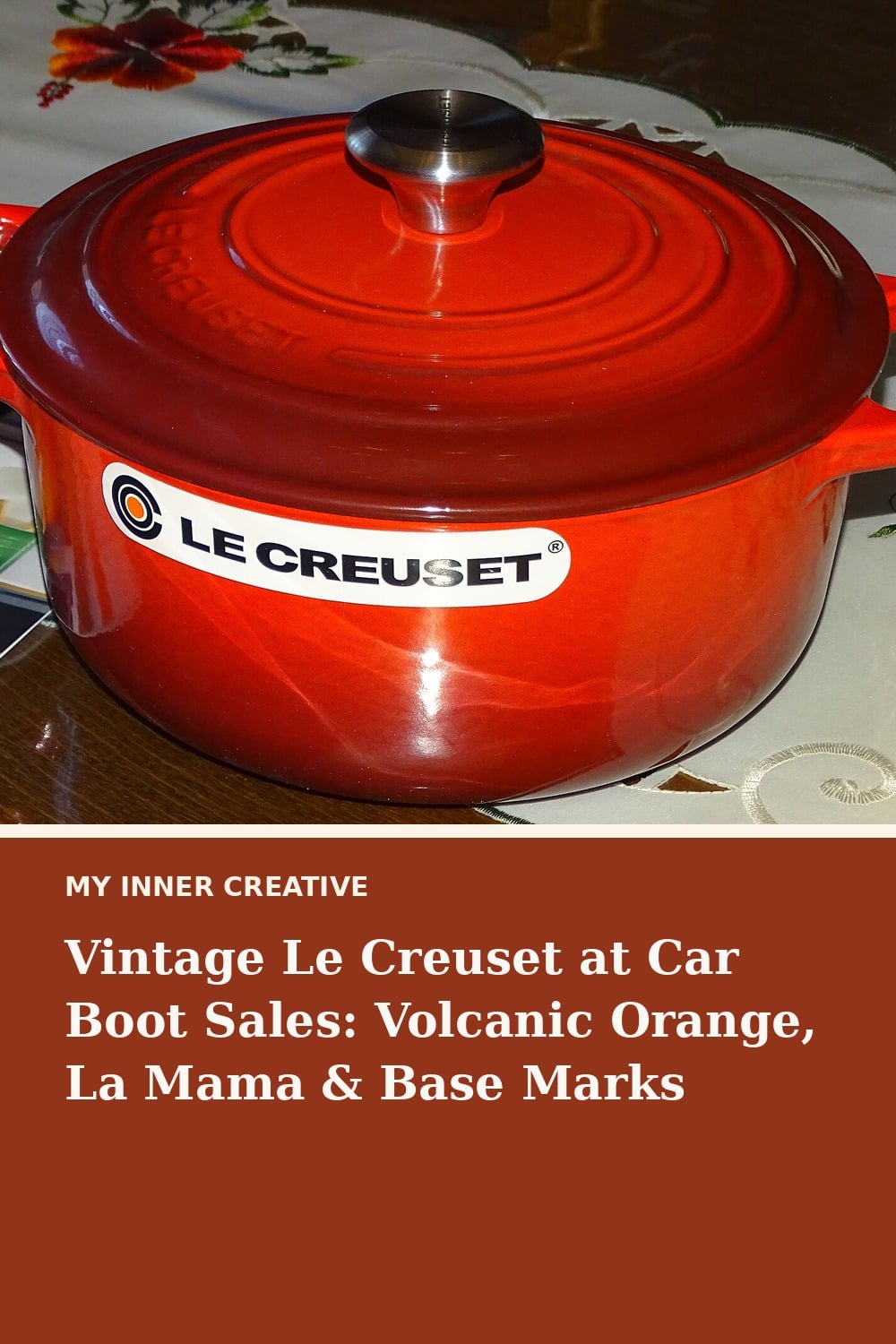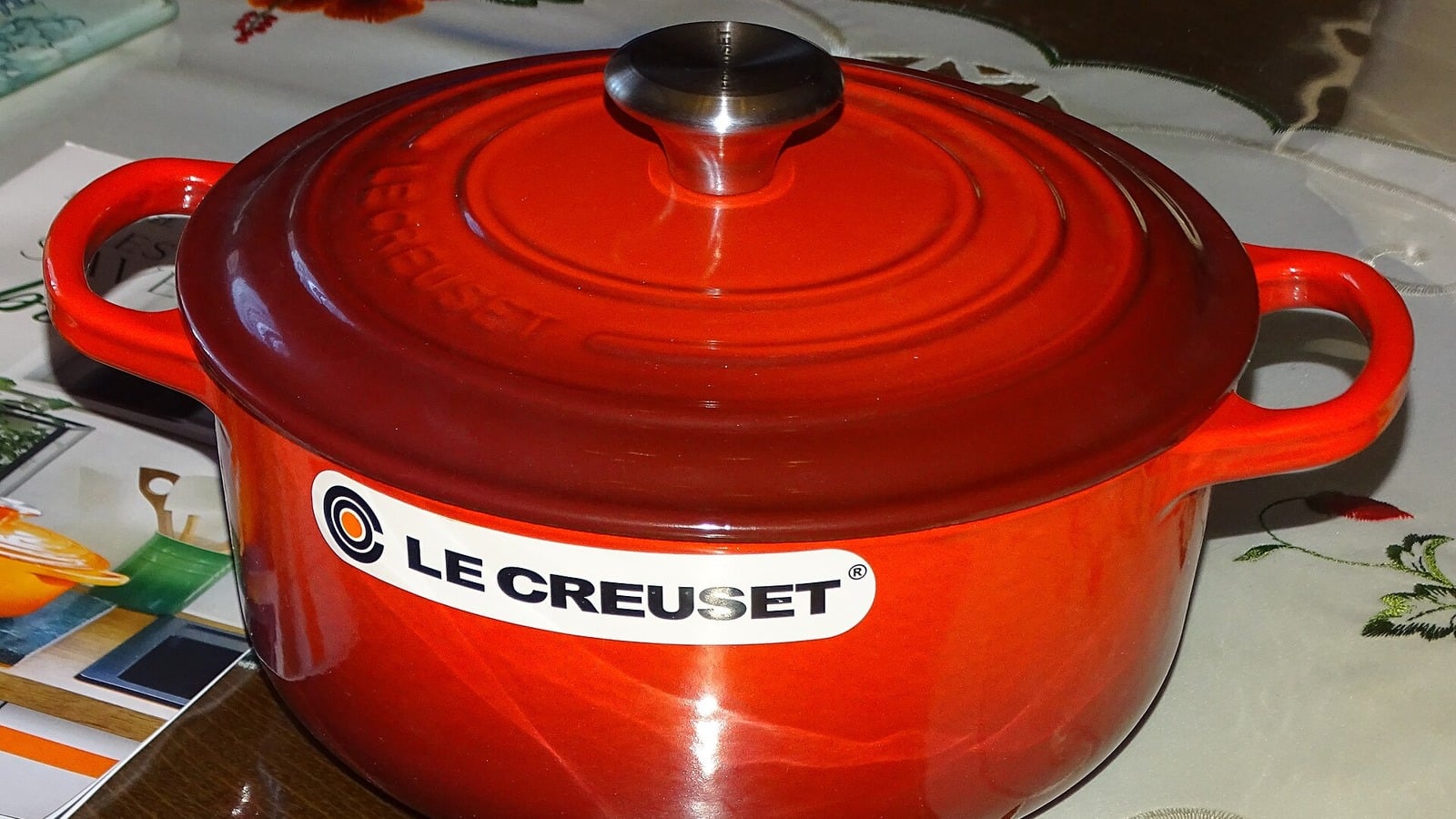
Three things are worth hunting for across a wet field of trestle tables: the volcanic orange that started the brand, the domed shape of Enzo Mari’s La Mama pot, and the marks cast into the base. None of those marks is a date code, which is the first thing to get straight before handing over cash. The Cook & Collect vintage Le Creuset dating guide states that no universal date-code system exists in official manufacturer sources, so a single stamp cannot tell you the year a pot left the foundry.
Two markings get misread constantly at car boot sales. Ordinary size numbers such as #17, #26 or #33 are size designations and never production years. Single foundry lozenge letters are not years either. They are clues to stack alongside the shape, the lid, and the state of the enamel.
Volcanic orange: the 1925 color that started everything
Le Creuset’s own account of its first color, Color Conversations: The Legend of Flame, says Flame, known as Volcanique in France, was introduced in 1925 and was Le Creuset’s first color, and that its enameled cast iron is handcrafted at the Fresnoy-le-Grand foundry in France.
The shade was inspired by molten cast iron poured from a crucible, and it carries a signature gradient from deep orange to light. That gradient is the single most useful visual reference on a stall, because it helps separate an early-style volcanic finish from a later flat solid color under gray morning light.
Two other details from that history are worth carrying down the rows. Enameled cast iron removed the need for pre-seasoning, and it brought color to a market filled with plain gray and black cast iron. Each piece is individually cast and handcrafted by 15 or more artisans, so small surface variations between two pots of the same size are normal rather than a fault.
Enzo Mari’s La Mama pot and the base checks to run at the stall
Enzo Mari’s La Mama collection, introduced in 1972/1973, is identified by its domed lids and ergonomic loop or tab handles. A La Mama piece is a named design with its own following, which changes what it is worth. Once the shape has caught the eye, the Cook & Collect sequence of checks works just as well beside a car boot table as it does at an auction preview.
- Read the whole underside, not just the center. Tilt the pot toward the light and look at the outer rim of the base near the foot. On early examples the cast LE CREUSET legend curves along that outer base rim in low relief, and it is easy to miss in center-only photos. Note whether FRANCE or MADE IN FRANCE appears, or whether no country mark is present at all, and check for casting rings or a smooth base finish.
- Look at how the lid handle is attached. Lid handles vary by era, and later pots often carry replaceable phenolic, metal or steel knobs. Knobs are easy to swap, so a knob on its own dates nothing.
- Check that the lid belongs to the body. Lids and bodies get mixed up over decades of use and resale, and boot sale boxes make that worse. Compare the enamel color under the same light, check whether the wear patterns agree, and sit the lid down to test the fit.
- Separate crazing from chips. Fine crazing and exterior rim wear are harmless on a vintage piece. Chipped or cracked interior cooking enamel is a different problem, because interior enamel damage affects both usability and resale value.
- Treat size numbers and lozenge letters as clues. A #26 or a #33 is a size designation, and a lozenge letter is a foundry mark rather than a year. Read them together with shape, base legend and condition.
What La Mama pots have sold for, and why no UK figure is verified
No verified UK sold price in pounds exists for these pots, so the honest benchmarks come from closed US estate auctions. They show what named designer pieces attract when bidders compete, even though a British field sale is a different market.
US estate-sale benchmark one: at Brown Button Estate Sales, a vintage #33 La Mama 8-quart Dutch oven from Enzo Mari’s 1973 design, described in good vintage condition with minor surface scratches, sold for $80 across 15 bids, excluding buyer’s premium. The sale closed between February 28 and March 3, 2025.
US estate-sale benchmark two: NM Estate Auctions, run by Mesilla Valley Estate Sales, sold a La Mama pair of a #26 at roughly 5.5 quarts and a #17 at roughly 1 quart in reddish-brown enamel for $101.99 across 35 bids. Both were marked with branding and size numbers on the base, and both showed patina with minor chipping and scuffing.
Read those two results together. Named designer pieces draw bidders, but condition sets the ceiling, and interior chips pull a lot of money out of a lot. A clean pot with a matching lid will usually beat a damaged example of the same size and color, whatever the currency.
That pattern holds across kitchen collecting generally. Condition and pattern recognition do the same work with Pyrex Turquoise Golden Birds thrift finds, where surface damage separates a display piece from a bargain. The same discipline applies to seasonal lots such as vintage Christmas baubles, where the condition of the finish drives the price.
So pack a torch, look for volcanic orange and a domed La Mama lid, turn the pot over, and give the foot rim the attention most boot sale buyers give the center.
Photo: Jérémy-Günther-Heinz Jähnick, CC BY-SA 3.0, via Wikimedia Commons.