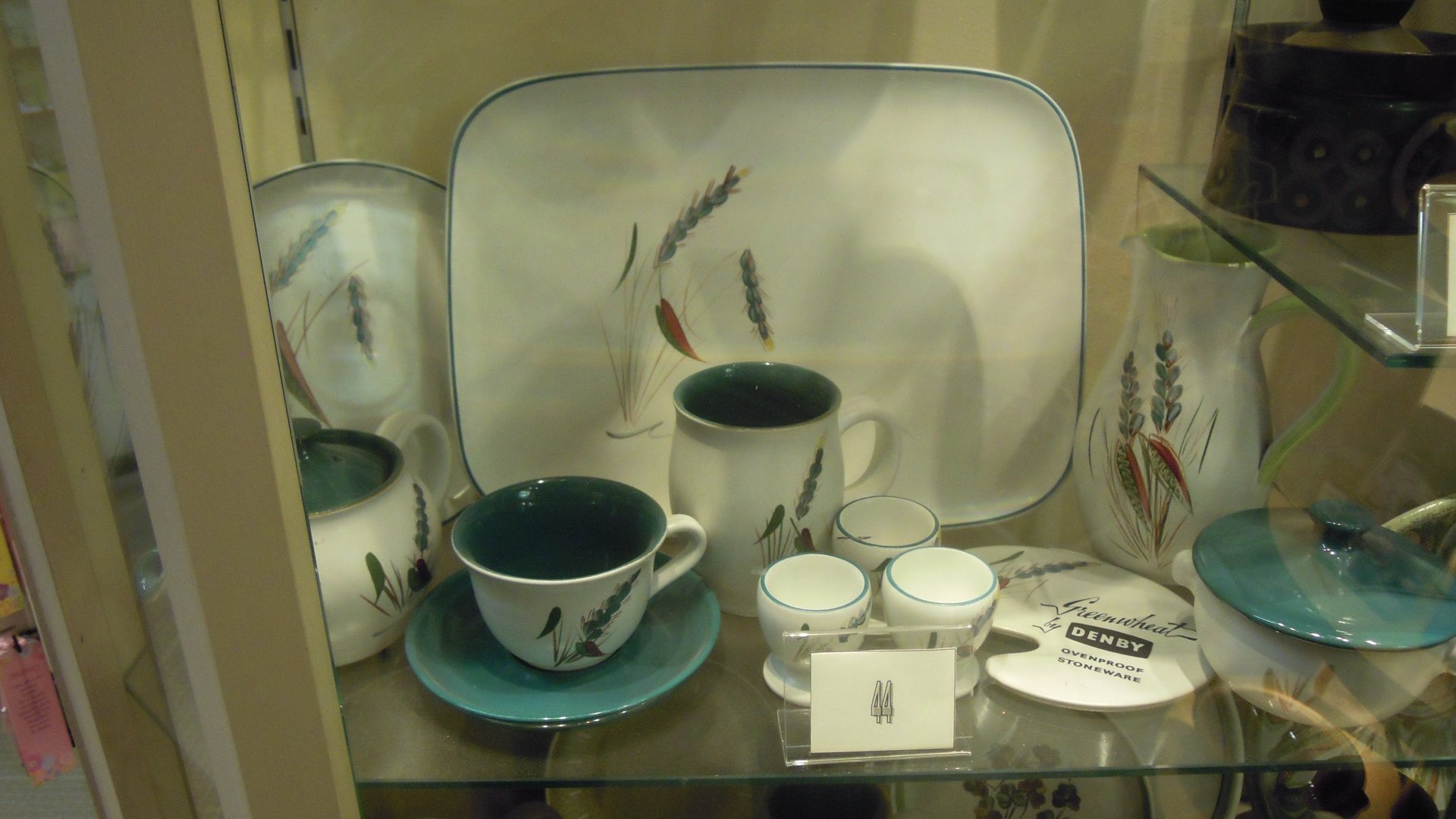
Featured image: A display of Denby Greenwheat in the museum at the Denby Pottery Visitor Centre in Derbyshire, photographed on 1 February 2013. Photo: Kolforn / Wikimedia Commons, CC BY-SA 4.0. Cropped to 16:9.
This guide covers two patterns of second-hand Denby stoneware from Derbyshire: Greenwheat, introduced in 1956, and Arabesque, designed by Gill Pemberton and dated from 1964 by CyCookery. The mark on the base can also give an approximate date. According to CyCookery, an impressed BOURNE DENBY points to about 1890 to 1940 and a printed DENBY with a country word points to about 1940 onwards. The site says microwave wording alongside an oven and dishwasher claim points to the 1980s.
The Denby dates in this guide come from two sources. One is CyCookery, read on 27 November 2026. The other is the Victoria and Albert Museum. CyCookery says the Denby factory in Derbyshire holds its own pattern and mark records.
Where Denby came from
Joseph Bourne opened the Denby works in 1809 to exploit a local clay, CyCookery says. For its first century the pottery made salt-glazed bottles and industrial ware.
Domestic tableware took over in the twentieth century. The site says the reduction-fired stoneware glazes arrived through the middle decades of that century.
CyCookery describes Denby as heavy, vitrified, reduction-glazed stoneware made for daily use, and says the pottery grew from a salt-glaze works into the country’s best-known ovenproof tableware. It says the company still makes in Derbyshire. Both patterns below are listed by the site as discontinued.
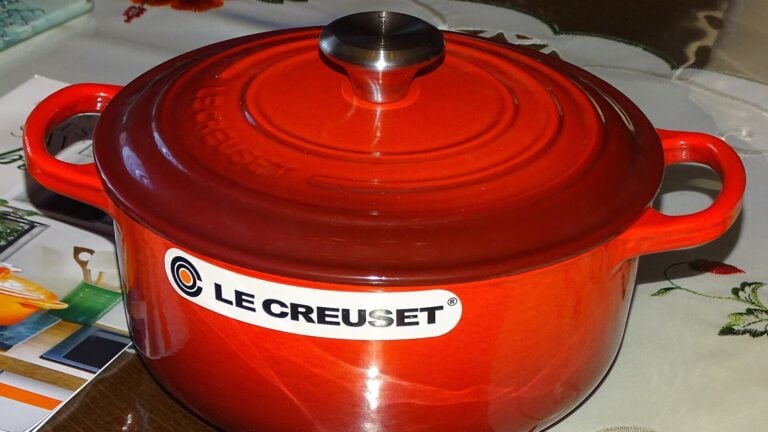
My Inner Creative also has a guide to Vintage Le Creuset worth looking for at car boot sales.
Greenwheat and Arabesque
Greenwheat ran from 1956 to 1997, according to CyCookery. The site describes hand-painted green ears of wheat on an oatmeal stoneware ground, with a darker green band at the rim. It says the ware is heavy, matt on the outside and glossy within.
Arabesque was designed by Gill Pemberton. The V&A credits her as Gill in its catalogue record, while its gallery label names her as Gillian.
The museum catalogues an Arabesque teapot under museum number C.85:1, 2-1997. The record describes buff stoneware, machine-made and glazed, with a dark brown semi-matt base glaze. Over this is an enamel pattern of circles and a central daisy, using red alongside brown and yellow. The record gives the mark as “Denby / Made in England”, printed in black.
CyCookery gives its own description of the Arabesque look, and it differs from the museum record. This guide follows the V&A teapot for how the pattern looks.
The dates for Arabesque vary slightly between the V&A’s own fields. The catalogue summary says Pemberton designed the teapot in 1962 to 1963, and the header gives it as made about 1963 to 1984. The gallery label, dated 23 May 2008, says “made 1964-84”. That 1964 to 1984 span is the one CyCookery also gives.
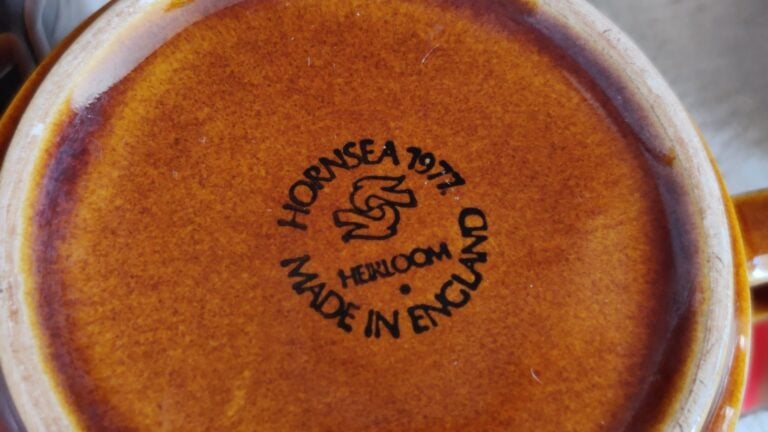
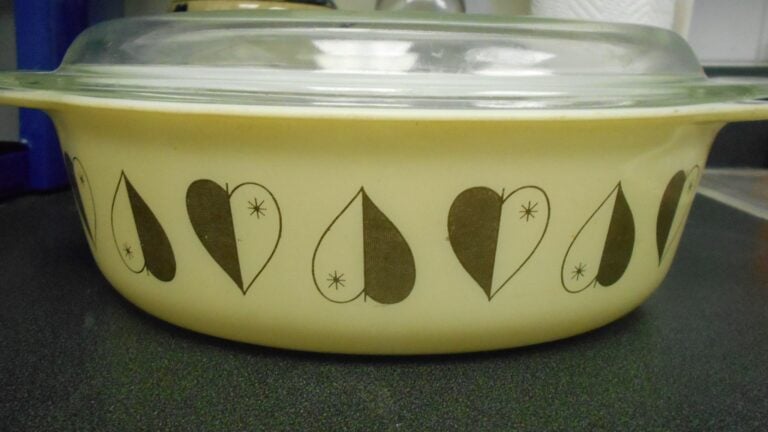
My Inner Creative has also looked at a 1960s Pyrex casserole in the Turquoise Golden Birds pattern. It also has a guide to reading the base marks on Hornsea Pottery.
Reading the backstamp and the care wording
CyCookery gives approximate dates for these Denby marks:
- Impressed BOURNE DENBY, about 1890 to 1940. This is the industrial and early domestic period, before the modern tableware ranges. The site names bottles and kitchen ware among pieces of this age.
- Printed DENBY with a country word, from about 1940. CyCookery calls this the modern tableware era. The black printed “Denby / Made in England” on the V&A teapot is a mark of this printed type.
- An oven and dishwasher claim, from about 1965 onwards.
On that last group, CyCookery says a dishwasher claim on the base dates a piece to the 1960s at the earliest, because a pottery only prints a dishwasher claim once its customers own dishwashers. It adds that any microwave wording alongside it takes the piece into the 1980s.
Pattern names are printed on most post-war Denby ware and have known introduction dates, the site says. It also says pattern names are the easiest thing to read on a base and the first thing to wear off. When a pattern name is legible, this guide suggests reading it first and then comparing the maker’s mark with the dates above.
On care, CyCookery calls Denby stoneware the easy case. It points to a vitrified body with the glaze fired with it, no gilding on most ranges, and a genuine oven and dishwasher claim.
The site still gives some cautions. It advises against preheating an empty stoneware dish or setting a hot one on a wet worktop. It says a few decorative ranges carry a metallic lustre that rules out the microwave. Its care panel lists dishwasher and microwave use, and adds: “A gold band overrides both”.
Very early salt-glazed Bourne ware is a different matter, according to CyCookery. The site says it is not tableware and is porous where the glaze is thin.
CyCookery says its care notes describe typical surviving pieces by the maker, and not any one of them. They are general guidance from the site and do not confirm how any single piece found second-hand will behave in a dishwasher or microwave.