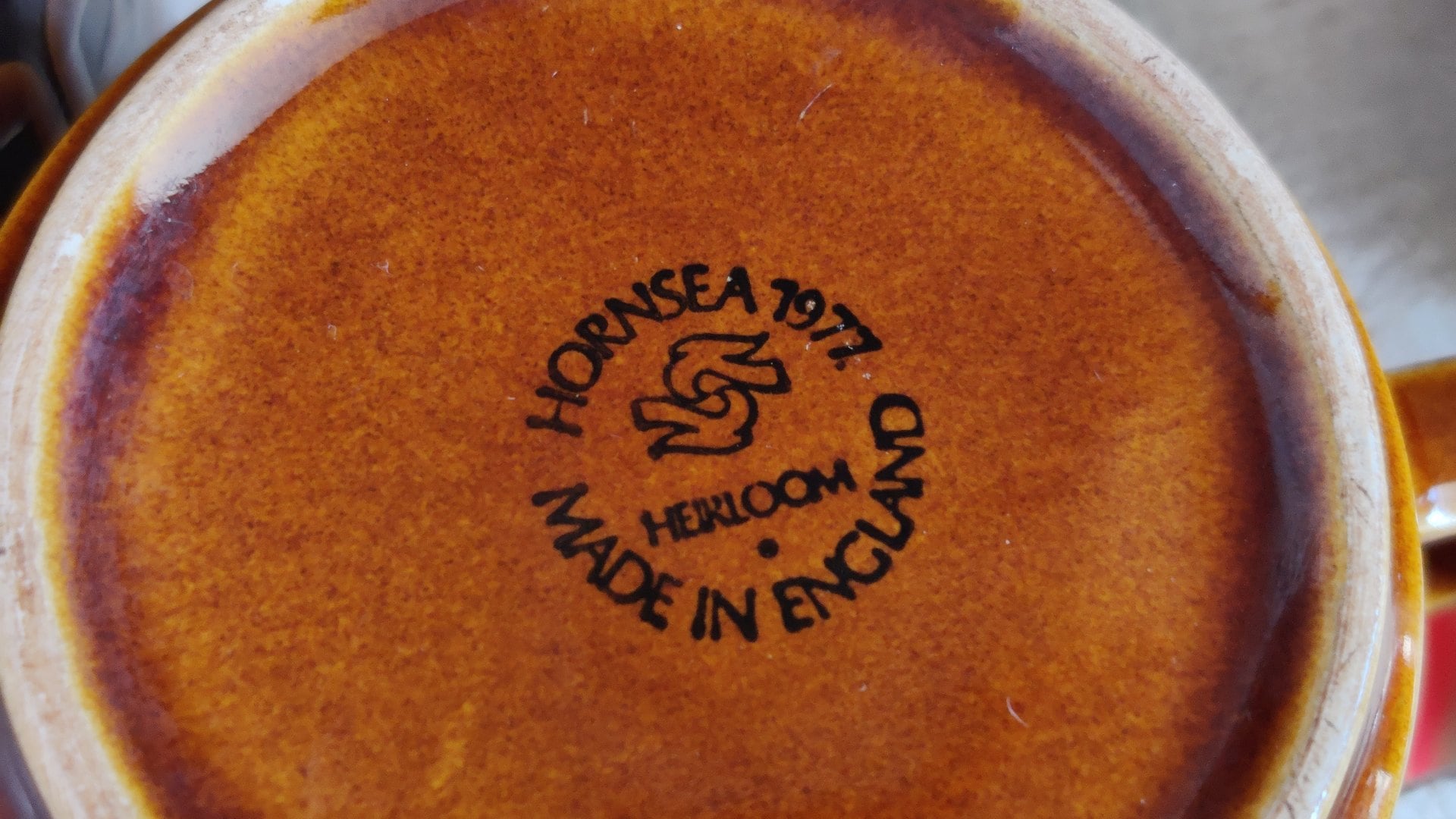
Featured image: The printed base mark on a brown Hornsea Heirloom coffee service piece, reading HORNSEA 1977 HEIRLOOM MADE IN ENGLAND, photographed on 10 December 2021 at a charity shop in Birmingham. Photo: Andy Mabbett / Wikimedia Commons, CC BY-SA 4.0. Cropped to 16:9.
Hornsea Pottery was made in Hornsea, East Yorkshire. Mid Century Form says most Hornsea found now is 1960s and 1970s tableware, including John Clappison’s Heirloom and Saffron ranges. Mid Century Form advises treating the year in a printed “Hornsea England” mark as the earliest likely date of manufacture. At a liquidation auction on 10 September 2024, a bidder in Telford paid £250 for a small collection of Saffron pattern pieces.
Hornsea Pottery and the Clappison ranges
According to a guide from Mid Century Form published on 14 November 2026, Hornsea Pottery was made in Hornsea from 1949 until the company went into receivership in 2000. Hornsea Pottery was also made at a second factory in Lancaster from 1974 to the late 1980s. The guide says sources differ on whether Lancaster closed in 1987 or 1988.
The guide says most Hornsea found now is 1960s and 1970s tableware, especially the Heirloom range, the Saffron range and the Bronte range. It says all three were designed by John Clappison. Ahead of a 2024 sale, Eddisons director Paul Cooper described Clappison as “the Hull butcher’s son” who became the pottery’s chief designer, as reported by the Holderness and Hornsea Gazette.
Heirloom dates from 1967. It has chunky shapes with a repeating printed pattern, mostly in brown, with blue and green versions too.
Saffron uses the Heirloom shapes, with caramel flowers on a burnt orange ground. The guide gives its introduction as around 1970, with production ended by 1992.
Bronte dates from the late 1960s and shares the same shapes as Heirloom and Saffron. Cooper described it as “the distinctive two-tone brown pattern”.
The guide says sources disagree on some of these dates. Wikipedia and one collectors’ feature give 1967 as the start for these ranges as a group, while a ceramics dealer and the Museum of the Home date Saffron’s production from 1970.
How to read a Hornsea base
The guide says the marks give a rough date on their own. A printed mark with a horn and two waves belongs to the 1950s to early 1960s. Printed “Hornsea England” marks with a year, such as “HORNSEA ENGLAND 1973” or “HORNSEA ENGLAND 1975 HEIRLOOM”, belong to the late 1960s and 1970s.
The year needs care. The guide’s advice is to treat it as “made in or after”. The V&A has a Clappison mug designed and first made in 1967 whose mark reads “HORNSEA ENGLAND 1973”. The year may show when that version of the stamp was introduced, or a later production run.
Collectors report Heirloom canisters with 1973, 1974 or 1976 in the mark, and others with no year at all. The guide says no source it found records when Hornsea stopped putting years in its marks.
Numbers pressed into the clay work differently. Impressed numbers such as 388, 602 or 603 are mould or shape numbers, and the guide says they are not dates. A four-digit number following “Hornsea England” in a printed mark is a year.
Doncaster Auction Centre described a trio of Saffron canisters whose base bears a circular printed mark reading HORNSEA 1977, SAFFRON, MADE IN ENGLAND, with a central stylised logo of two interlocking S shapes.
The guide sets out a step-by-step method for anyone checking a base:
- Write down the mark exactly, including any range name and year.
- Note whether it is impressed, incised or printed, and its colour.
- Look for a horn and waves. If present, think 1950s to early 1960s.
- If there is a year, treat it as the earliest likely date of manufacture.
- Match the range and shape with documented examples.
What a few Hornsea pieces have fetched at auction
The headline figure comes from a sale by Scunthorpe auctioneers Eddisons on Tuesday 10 September 2024, reported by the Gazette on 12 September 2024. The auction followed the closure of one of the last retail outlets in Hornsea selling the designs, and was ordered as part of the liquidation of Hopfrog, which was based at Hornsea Freeport. Hopfrog started as a craft beer retailer, became a café bar and then added the Hornsea Pottery Design Shop. Kingsbridge Corporate Solutions of Hull instructed Eddisons to sell the remaining stock.
After the sale, Cooper said some 300 people were involved in the bidding. A bidder in Telford paid £250 for a small collection of Saffron pattern pieces. A buyer in Birmingham paid £150 for lots of Heirloom and £160 for Bronte.
Doncaster Auction Centre’s lot 18, in its “Antiques, Estate & Job Lot Auction” that ended on 20 May 2026, was the trio of Saffron canisters described above. One is marked TEA, one is marked COFFEE and the third is an unlabelled lidded jar, all with flat wooden lids.
The lot is listed as sold for £16, against an estimate of £10 to £20 and a start price of £10. The lot page also lists an 18% buyer’s premium.
These figures are from the Hopfrog liquidation auction and the Doncaster Auction Centre sale. Neither is a valuation, and neither is a car boot price.
The site also covers vintage Le Creuset worth looking for at car boot sales, a 1960s Pyrex casserole in the Turquoise Golden Birds pattern and a guide to second-hand Denby stoneware and its backstamps.