Literary bullet journal themes for 2027: Wonderland, Narnia and Austen spreads
Featured image: John Tenniel’s illustration from The Nursery “Alice” (1890), public domain. This is Tenniel’s illustration, not a bullet journal spread.
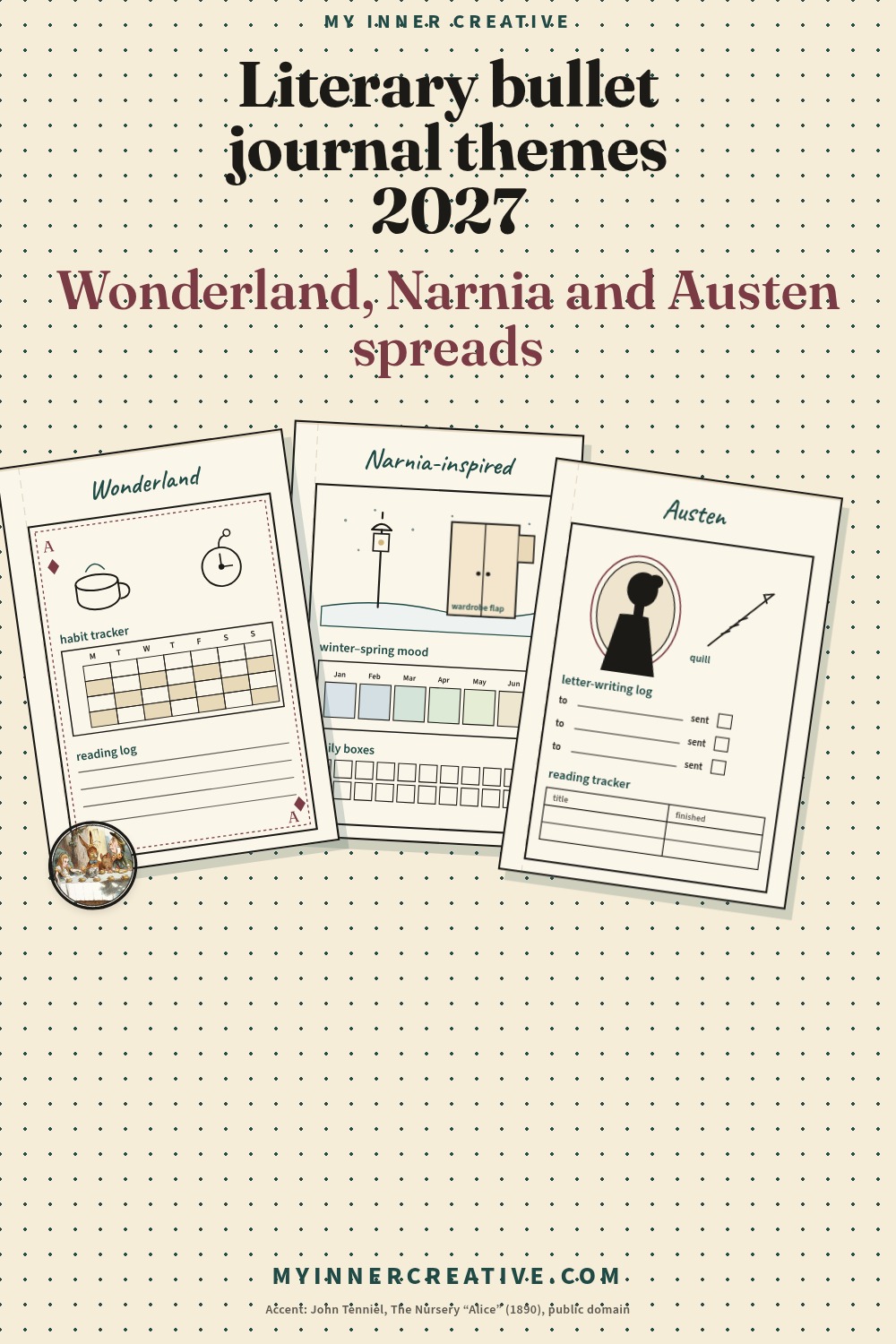
Wonderland, Narnia and Jane Austen’s novels each carry enough visual shorthand to fill a bullet journal month, so they line up as a literary set for 2027. Three worlds, three monthly covers, and a tracker on every spread: run them back to back as a bookish quarter, or space them across the year.
Every layout below is described in words so you can rule it yourself on a blank or dot-grid page. That matters for more than style. Copying someone else’s finished spread from Pinterest, Instagram or Etsy is not the same as drawing your own, and the line between inspiration and copying is worth settling before you pick up a pen. For more themes to slot around these three, the A–Z list of bullet journal themes runs through ideas alphabetically.
Wonderland: playing-card borders, teacups and a checkerboard habit tracker
Alice’s Adventures in Wonderland was published in 1865, and John Tenniel provided 42 wood-engraved illustrations for the original edition. Lewis Carroll died on 14 January 1898 and Tenniel on 25 February 1914, so Carroll’s text and Tenniel’s illustrations are in the public domain. Later studio and screen designs are not, so keep every doodle your own.
Build the monthly cover from the card suits. Rule a one-inch border around the spread and fill it with alternating hearts, spades, clubs and diamonds in black and red. Letter the month inside the frame in a tall serif, then tuck a teacup, a pocket watch on a chain and a small bottle with a hand-lettered tag into the lower corners.
For the habit tracker, rule a grid with one column per day of the month and one row per habit, then shade alternate squares black before you write anything, so the block reads as a checkerboard. Habits go down the left margin, dates across the top. Mark a finished day with a small red heart in the pale squares and a white gel pen in the dark ones.
The reading log works as a tea tray. Draw a stack of teacups up the right-hand page, one cup per book, each with a ruled line beside it for the title and the date you finished it. Color in the tea as you read, and pencil your running total into a pocket-watch face at the top. For a wider collection of Alice ideas from other journalers, see the Alice in Wonderland spread roundup.
A Narnia-inspired winter theme: a lamppost, a wardrobe-door flap and a snow-to-spring tracker
C. S. Lewis’s seven novels were published between October 1950 and September 1956, starting with The Lion, the Witch and the Wardrobe in 1950. Those books remain in copyright, as do Pauline Baynes’s illustrations for them; she died in 2008. NARNIA is also a registered US trademark, Reg. 3177587, held by C.S. Lewis (Pte.) Ltd. Use the name to describe your theme and nothing else: no Baynes drawings, no cover art, no logos or screen artwork. The motifs below are generic winter shapes you draw yourself.
Start the cover with a single lamppost on the right-hand page, drawn tall and thin so the lantern sits level with the month title. Stipple snow around the base with a fine liner, leave the top third of the page white, and ink a line of fir trees along the gutter.
The wardrobe door folds. Glue in a strip of cardstock the width of your spread, score it down the center and fold the two halves back to meet in the middle. Draw paneled doors with a small round handle on the outside, and keep the month at a glance behind them: dates down the left, appointments to the right.
For the mood tracker, draw a bare branch across the bottom of the left-hand page with one bud for each day of the month. Pick four colors that move from snow white and pale gray through gray-green to blossom pink, and fill one bud a day in the shade that matches how the day went. By the end of the month the branch reads as a winter-to-spring gradient. Pair it with a reading tracker: a shelf of blank book spines to letter as you finish titles. There are more versions of that layout in this guide to book and reading trackers.
Austen: a Regency silhouette frame, a quill and a letter-writing log
Jane Austen is known mainly for her six novels: Sense and Sensibility, Pride and Prejudice, Mansfield Park, Emma, Northanger Abbey and Persuasion. The novels are in the public domain, so you can letter lines from them across a page. Screen adaptations are not, so draw your own figures rather than copying a face from a still.
Center the cover on an oval silhouette frame. Rule an oval about four columns of dots wide, ink a beaded or scalloped edge around it, fill the inside solid black, then lift a profile out of it in white gel pen: a knot of hair, a high collar, a ribbon. Add a quill and inkwell below, and letter the month in looped script.
The letter-writing log suits the theme and stays useful all year. Rule four narrow columns across a half page — date, to whom, sent, reply received — and draw a folded letter with a wax seal in the top corner. Tick the seal when a reply lands.
For the reading tracker, borrow the shape of a dance card: a numbered two-column list down one side of the page, with a ruled line for each title and a small box for a star rating. Six boxes along the bottom, one per Austen novel, let you mark off the set if that is your 2027 project. The same card format scales up to a whole-year log, and this walkthrough on book trackers in your bullet journal covers the columns worth keeping. To run one continuous log underneath all three themes, set up the 2027 reading tracker first and let the monthly covers change around it. A year-in-review spread for the last week of December 2026 can sit just before that yearly log begins.